What we've learned working specifically in this market: the problem almost never starts with the mold itself. It starts with a system that's oversized, a drain line that isn't maintained, ductwork that sweats in an unconditioned attic, or an installation that doesn't account for the moisture load a Central Florida home puts on an HVAC system every single day. Treat the symptom without addressing those conditions and the mold comes back. Every time.
This page gives Deltona homeowners what we'd share with a neighbor before spending a dollar on any mold-related product or service — the specific conditions that drive mold growth in this climate, where to look for them inside your system, and what actually resolves them at the source, helping homeowners benefit from top HVAC system installation near Deltona FL that supports cleaner airflow and healthier indoor environments.
TL;DR Quick Answers
Top HVAC System Installation Near Deltona FL
Finding top HVAC installation near Deltona FL means more than finding the lowest bid. Here is what separates a quality installation from a costly mistake in this market:
Verify the contractor first:
Active Florida DBPR license — confirmed at myfloridalicense.com
Volusia County mechanical permit pulled by the contractor — not the homeowner
Manual J load calculation completed before any equipment is selected
What a complete Deltona HVAC installation includes:
Correct system sizing based on your home's actual load — not square footage
Full duct assessment and R-8 minimum insulation in unconditioned attic spaces
Properly pitched condensate drain with secondary drain and float switch
Post-installation performance check confirming airflow, humidity removal, and refrigerant charge
What it costs:
Typical range: $5,000 to $12,000 or more depending on duct condition, electrical scope, and equipment selection
A complete estimate is itemized — equipment, labor, permits, and duct work listed separately
Best system for Deltona's climate:
High-efficiency heat pump or split-system central AC paired with variable-speed air handling
Variable-speed systems manage humidity — not just temperature — which is the defining performance factor in Deltona's hot-humid climate
Why it matters:
47% of U.S. homes have dampness or mold problems
Indoor RH above 60% drives mold growth — an oversized, incorrectly installed system is a primary cause
Dampness and mold exposure increases respiratory problems by 30 to 50%
In Deltona's climate, the best HVAC installation isn't the cheapest one or the fastest one. It's the one done correctly — sized to the home, permitted through Volusia County, and built to manage humidity from day one.
Top Takeaways
Mold is a symptom, not the root problem. Recurring HVAC mold in Deltona homes traces back to one of three conditions:
Oversized system short-cycling before it can dehumidify
Clogged or improperly pitched drain line
Under-insulated ductwork sweating in a 130°F attic
Treating the mold without correcting the HVAC condition is a delay, not a solution.
Humidity control matters more than cooling capacity in Deltona's climate. The EPA identifies indoor RH above 60% as a primary mold driver. An oversized system that hits the temperature setpoint but never pulls moisture creates a mold condition — even when the thermostat reads correctly. A documented Manual J load calculation is what prevents it.
47% of U.S. homes have dampness or mold problems — and improper HVAC installation is a leading contributor. In Deltona's hot-humid climate, equipment brand and efficiency rating matter far less than whether the system was sized, installed, and set up correctly from day one.
Verify your contractor before signing anything. Three non-negotiables before work begins:
Active Florida DBPR license — confirmed, not assumed
Mechanical permit pulled by the contractor — not the homeowner
Documented Manual J load calculation — on paper, not estimated
Dampness and mold exposures increase respiratory problems by 30 to 50% — with 21% of U.S. asthma cases potentially linked to home dampness and mold. For Deltona households with children, elderly residents, or anyone managing a respiratory condition, correcting an HVAC moisture problem isn't routine maintenance. It's a direct intervention in the air your family breathes every day.
Deltona's Climate Creates Mold Conditions That Most HVAC Systems Aren't Built to Handle Alone
Central Florida's humidity doesn't take a season off. Deltona sits in a climate zone where indoor relative humidity can exceed 60 percent for the majority of the year — and 60 percent is precisely where mold begins to thrive. Most HVAC systems are designed to cool air. Managing moisture is a separate function, and one that requires the system to be correctly sized, properly installed, and consistently maintained to perform it well.
What we see repeatedly in Deltona homes: a system that was oversized at installation short-cycles — it cools the air quickly but doesn't run long enough to pull moisture out. The temperature drops. The humidity stays. And inside the dark, damp environment of the air handler, evaporator coil, and ductwork, mold has everything it needs.
The Evaporator Coil and Air Handler Are Where Mold Most Commonly Starts
The evaporator coil is the coldest, wettest surface inside your HVAC system. Warm, humid air passes over it continuously, condensation forms, and without adequate drainage and airflow, moisture accumulates. In Deltona's climate, that process happens at an intensity most cooler markets never experience.
Signs that mold has established itself in or around the evaporator coil and air handler:
A musty odor that appears immediately when the system turns on
Visible dark spotting on or near the air handler cabinet
Allergy or respiratory symptoms that improve when you leave the home
Condensation on supply vents or registers shortly after the system runs
Left unaddressed, mold at the coil level distributes spores through every supply duct the system serves — reaching every room in the home every time the fan runs.
A Clogged or Improperly Pitched Drain Line Is the Most Preventable Driver of HVAC Mold in Deltona
The condensate drain line removes the moisture your evaporator coil collects. In Deltona's climate, that line handles a significant volume of water — particularly during the May through September peak season when outdoor humidity is at its highest. When the line clogs, backs up, or wasn't pitched correctly at installation, standing water accumulates in the drain pan. Standing water in a warm, dark environment is one of the most reliable conditions for mold growth we encounter in this market.
What a properly maintained condensate system requires:
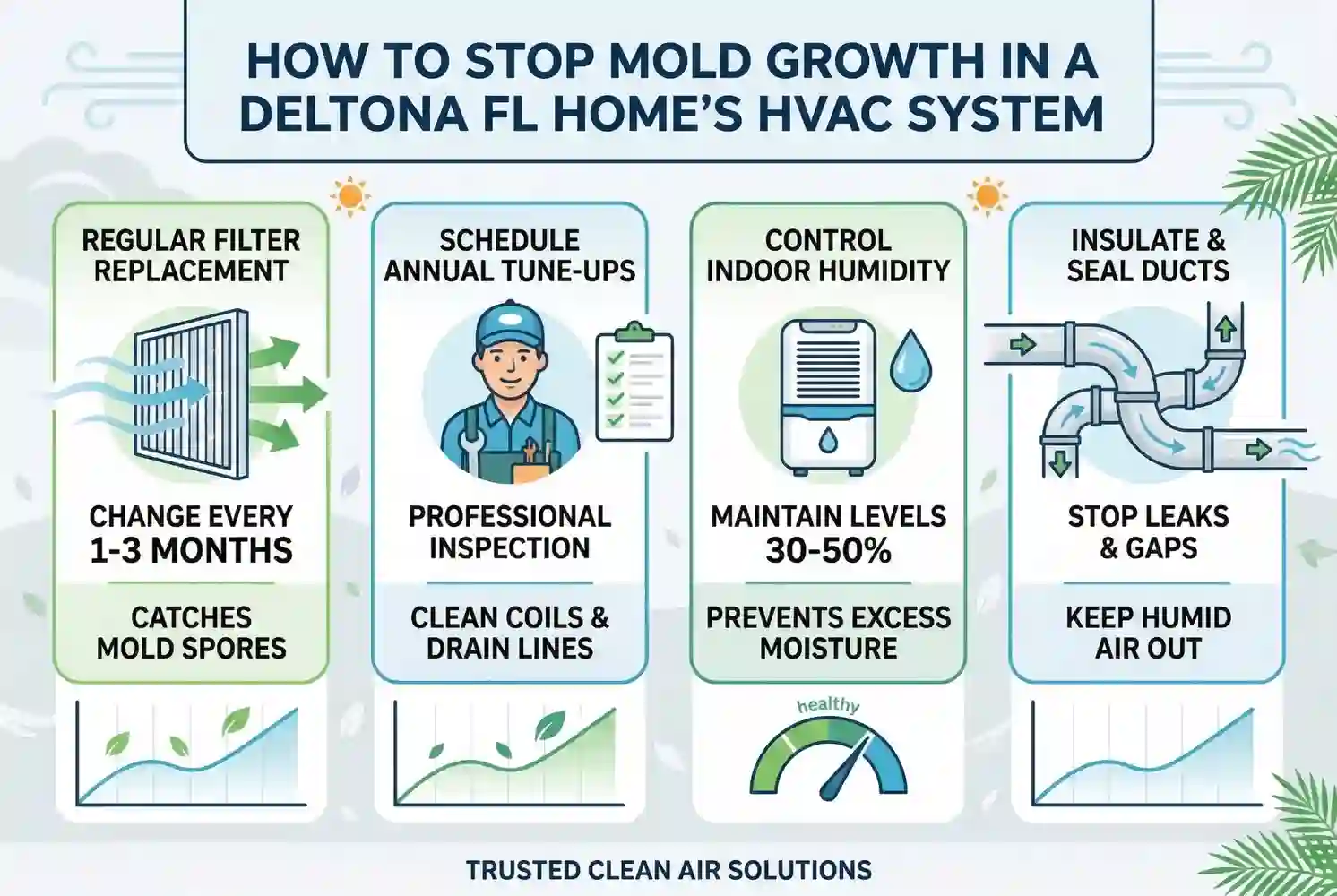
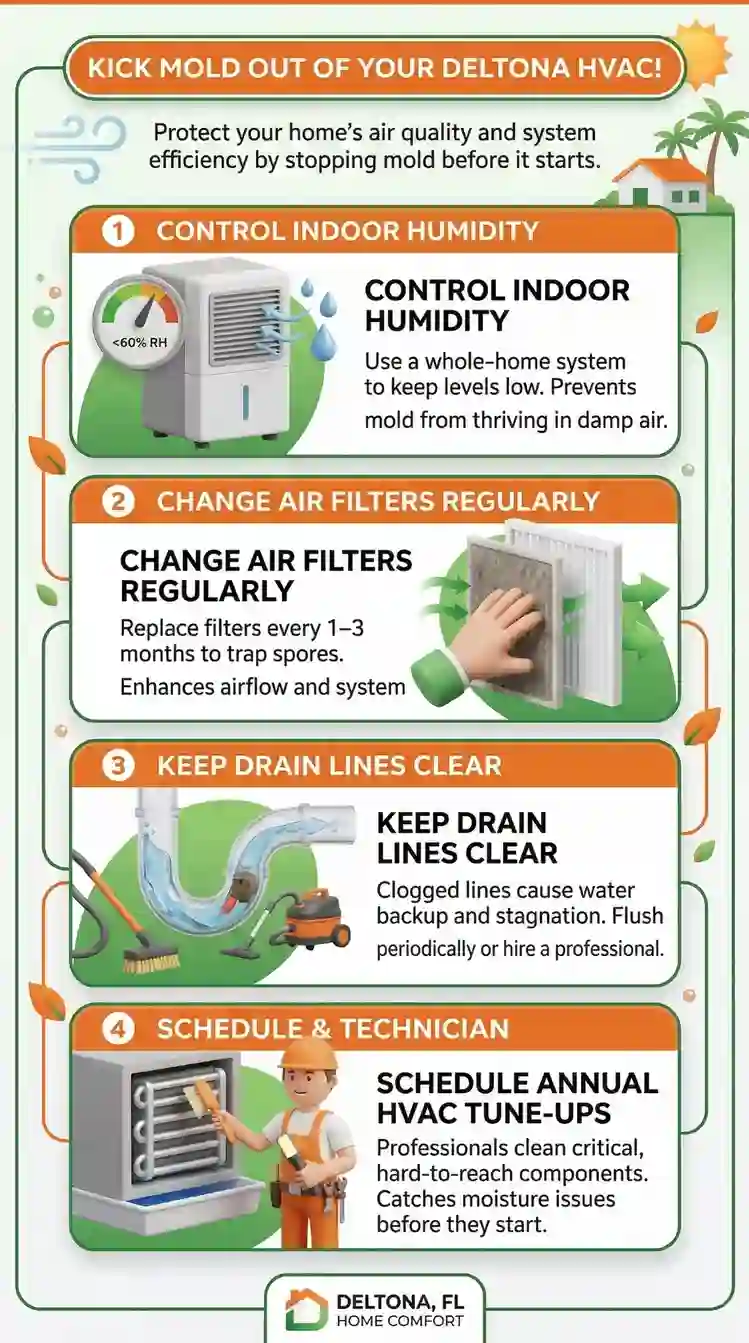
Drain line flushed with a diluted bleach solution at least once per year — twice during peak humidity months
Drain pan inspected at every maintenance visit for standing water, staining, or biological growth
Correct pitch confirmed at installation — water must flow toward the drain, not pool
A condensate overflow switch installed to shut the system down before water damage occurs
This is one of the most common mold sources we find in Deltona homes — and addressing it early often leads homeowners to seek an HVAC system installation service near me to ensure their system supports proper airflow, moisture control, and healthier indoor air.
Ductwork in Unconditioned Attic Spaces Creates a Mold Risk Most Homeowners Can't See
A large share of Deltona homes have ductwork running through unconditioned attic spaces. In summer, attic temperatures in Central Florida regularly exceed 130 degrees. When cool, conditioned air moves through ducts surrounded by that heat, the outer surface of the duct can drop below the dew point of the surrounding air — causing condensation to form on the outside of the duct itself.
That condensation, combined with attic dust and organic material, creates surface conditions where mold establishes and spreads — often undetected for years. By the time a homeowner notices a problem, the ductwork may have been supporting mold growth through multiple HVAC seasons.
What to address in homes with attic ductwork:
Duct insulation rated at R-8 minimum — R-6 is insufficient in Deltona's climate
All duct connections sealed with mastic — not tape, which degrades in attic heat
Ductwork inspected for tears, separations, and moisture staining at every maintenance visit
Return air ducts assessed for negative pressure that draws unconditioned attic air into the system
An Oversized System Is a Mold System in Deltona's Climate
This is the connection most homeowners never hear from a contractor: oversizing and mold are directly linked in a hot-humid climate. An oversized system reaches the thermostat's target temperature too quickly, shuts off before completing a full dehumidification cycle, and allows indoor relative humidity to remain elevated even as the temperature stays comfortable.
In Deltona, that means a home that feels cool but maintains humidity levels where mold growth is not just possible — it's predictable. The fix isn't a mold treatment. It's a correctly sized system based on a Manual J load calculation that accounts for the actual moisture load the home produces.
If your system is relatively new but mold keeps returning, oversizing is the first variable worth investigating.
Air Filtration and UV Treatment Support Mold Prevention — But Don't Replace It
We're frequently asked about UV light systems and high-MERV filtration as mold solutions. Our honest answer: they're valuable supporting tools, not primary solutions. A UV-C light installed at the evaporator coil can inhibit mold growth on that surface effectively. A MERV 11 or higher filter reduces the organic particulate matter that mold feeds on inside the duct system.
What they cannot do is compensate for:
A drain line that isn't maintained
An oversized system that doesn't complete dehumidification cycles
Ductwork in an unconditioned attic without adequate insulation and sealing
An air handler that hasn't been cleaned in multiple seasons
Used alongside a properly sized, correctly installed, and consistently maintained system — UV treatment and quality filtration meaningfully reduce mold risk. Used as a substitute for those fundamentals, they delay the problem rather than resolve it.
Routine Maintenance Is the Most Reliable Mold Prevention Strategy Available to Deltona Homeowners
Everything we've described — coil condition, drain line function, duct integrity, system sizing — comes into view during a properly performed maintenance visit. In Deltona's climate, that means twice-yearly service at minimum: once in early spring before peak season begins, and once in fall after the heaviest humidity months have passed.
What a mold-preventive maintenance visit should include:
Evaporator coil cleaning — removing biological buildup before it establishes
Condensate drain line flush and drain pan inspection
Duct condition assessment — looking for moisture staining, separation, and insulation degradation
Filter inspection and replacement
Airflow and refrigerant charge verification — confirming the system is completing full dehumidification cycles
Humidity level check — confirming indoor relative humidity is consistently below 60 percent
In our experience, the Deltona homeowners who never deal with recurring mold in their HVAC systems aren't doing anything extraordinary. They're doing these six things consistently, twice a year, with a contractor who knows what to look for in this specific climate and understands the importance of сhооsіng the bеst HVAC sуstеm fоr уоur home.
"In our years servicing HVAC systems across Deltona, the homes with recurring mold problems almost never have a mold problem at their core — they have a humidity problem, a drain line problem, or a sizing problem that mold is simply the visible consequence of. We've walked into homes where a homeowner had treated the same mold growth three times in two years, each time spending money on remediation, each time watching it return within a season. In every one of those cases, the root condition was still present. The system was oversized and short-cycling. The drain line hadn't been maintained. The ductwork in the attic was under-insulated and sweating. Mold doesn't persist in a well-maintained, correctly sized HVAC system in Deltona because it can't — the conditions that allow it to establish simply aren't there. That's not a product recommendation or a service pitch. It's what we've observed in this market, in real homes, over years of doing this work. Fix the condition. The mold doesn't come back."
Essential Resources
1. Confirm Your Contractor Is Licensed to Work in Florida Before Anyone Steps Foot in Your Home
Florida DBPR License Verification Portal Florida DBPR License Search
We've walked into homes throughout Volusia County where previous HVAC work was done by someone who either held the wrong license type or wasn't licensed at all — and the homeowner had no idea until something went wrong. Florida law requires HVAC contractors to hold a valid state license before performing any installation work. Take 60 seconds to search by name or license number and confirm active status, license type, and disciplinary history before you sign anything.
2. Know Exactly What Volusia County Requires Before HVAC Work Begins at Your Property
Volusia County Building and Code Administration — Permit Center Volusia County Permit Center
One thing we tell every Deltona homeowner before installation: the permit has to be pulled by your licensed contractor — not you. If a contractor asks you to pull it yourself, that's a signal worth paying attention to. This resource covers permit requirements, application procedures, and what compliant inspections look like so you're not navigating the process blind.
3. Understand the Load Calculation Standard That Determines Whether Your New System Is Actually the Right Size
ACCA Manual J — Residential Load Calculation (ANSI Standard) ACCA Manual J Standard
After years of serving homes across Deltona, the single most common installation mistake we see isn't the equipment — it's the sizing. Manual J is the nationally recognized ANSI standard for determining the correct size of a residential HVAC system, and it's required under Florida's building code. Knowing what this calculation involves helps you ask the right questions and recognize when a contractor is guessing instead of measuring.
4. Find Out If Your New HVAC System Qualifies for a Federal Tax Credit Before You Buy
ENERGY STAR — Federal Tax Credits for Energy Efficiency ENERGY STAR Federal Tax Credits
If you're replacing your system, this is worth checking before you finalize equipment decisions — not after. Qualifying HVAC equipment, including heat pumps and high-efficiency central air conditioners, may be eligible for a federal tax credit of up to 30% of project costs through the end of 2025. This resource explains current eligibility requirements, annual credit limits, and how to claim the credit when you file.
5. Learn Why Humidity Control — Not Just Cooling Capacity — Determines Whether an HVAC System Actually Performs in Deltona
U.S. Department of Energy — Efficient Cooling for Hot, Humid Climates DOE Efficient Cooling for Hot, Humid Climates
Living and working in Central Florida, we see this regularly: a system that cools the air temperature down but leaves the home feeling damp, clammy, and uncomfortable. In Deltona's climate, an HVAC system that doesn't adequately dehumidify creates the exact conditions that allow mold to establish — even when the thermostat reads correctly. This DOE resource explains why latent load management matters more here than almost anywhere else in the country.
6. Know What the EPA Says About Mold in HVAC Systems — and When Duct Cleaning Is Actually Warranted
U.S. EPA — Should You Have the Air Ducts in Your Home Cleaned? EPA Duct Cleaning Guide
We're honest with the homeowners we serve: duct cleaning isn't always necessary, and not every contractor who recommends it is acting in your best interest. The EPA recommends it only under specific conditions — including visible mold growth inside ducts or on system components. This guide helps you tell the difference between a legitimate remediation recommendation and an unnecessary upsell, and gives you the right questions to ask any service provider.
7. Understand the Health Risks Linked to HVAC Mold Exposure So You Know When a Problem Needs Professional Attention
CDC — Mold Health Effects CDC Mold Health Problems
We care about the families in the homes we work in — and that means being straightforward about what untreated HVAC mold exposure can do over time. Research links damp, mold-affected indoor environments to respiratory symptoms, asthma onset or worsening, allergic rhinitis, and other chronic conditions. If anyone in your household is experiencing unexplained respiratory issues, this CDC resource helps you understand whether your HVAC system's moisture or mold condition may be a contributing factor worth addressing.
These resources help homeowners prepare for a professional HVAC system installation service by verifying contractor licensing, understanding permit requirements, reviewing proper load calculation standards, exploring available tax credits, and learning how system design affects humidity control, indoor air quality, and long-term HVAC performance.
Supporting Statistics
Approximately 47% of U.S. homes have dampness or mold problems — conditions that an improperly sized, poorly maintained, or inadequately dehumidifying HVAC system either creates or fails to prevent.
That figure has never surprised us. Serving homes across Deltona and Volusia County, here's what we find regularly in the field:
Duct insulation sweating through the wrap in unconditioned attics
Air handler drain pans that haven't been serviced in years
Living rooms that smell like mildew while the thermostat reads 74°F
The equipment was running. The humidity was winning. In Deltona's climate, a system that isn't properly sized, maintained, and matched to the home's actual moisture load doesn't just underperform — it creates the exact conditions behind that statistic. The 47% isn't an abstract national figure to us. It maps directly onto what we see in this market.
Source: Fisk WJ, Mudarri D. Health and economic impacts of dampness and mold. Indoor Air, June 2007 — via National Institute of Environmental Health Sciences, Environmental Health Perspectives
The EPA identifies indoor relative humidity above 60% as a primary driver of mold growth — and recommends maintaining indoor RH between 30% and 50% to keep conditions below the threshold where mold can establish and spread.
Most Deltona homeowners are focused on temperature. The air tells a different story. What we find in oversized installations follows a consistent pattern:
System cools the air quickly and hits the setpoint
Shuts off before running long enough to pull moisture
Temperature drops — humidity doesn't
Result: 74°F and 68% relative humidity
That's not comfortable. That's a mold condition dressed up as a cooling success.
Source: U.S. EPA — Mold Course Chapter 2: Mold and Moisture Control
Research published in Environmental Health Perspectives found that dampness and mold exposures increase the occurrence of respiratory problems by 30 to 50%. The same assessment found that 21% of current U.S. asthma cases may be attributable to dampness and mold in homes.
The reason we walk homeowners through exactly what we found — the clogged drain line, the sweating duct, the fouled evaporator coil — isn't to add line items to an estimate. It's because we've seen the pattern play out in real homes:
Children with recurring cough
Adults managing worsening allergies
Families with no connection between their symptoms and the system running overhead every day
Correcting an HVAC mold condition in Deltona isn't a maintenance upgrade. For some households, it's a health intervention.
Source: Fisk WJ, Lei-Gomez Q, Mendell MJ. Meta-analysis, Indoor Air, June 2007 — via National Institute of Environmental Health Sciences, Environmental Health Perspectives
Final Thoughts
Mold in a Deltona home's HVAC system gets misread almost every time. Homeowners treat it as a mold problem. They spend money on remediation, feel good about the outcome, and watch it come back within a season.
What they were actually dealing with was a humidity problem, a drainage problem, or a sizing problem. The mold was the symptom. The HVAC system was the cause.
After servicing systems across Volusia County for years, here is the pattern we see consistently:
Homes with recurring mold problems almost always have recurring HVAC problems that were never fully resolved
Remediation without addressing the root condition isn't a solution — it's a delay
Mold doesn't persist in a correctly sized, properly maintained system because the conditions that allow it to establish simply aren't there
A new installation only solves a mold problem if the installation itself is done correctly
Most homeowners evaluate a new HVAC system by brand and efficiency rating. Those things matter. But they matter considerably less than:
Whether the contractor sized the system to the home's actual load — not square footage
Whether ductwork was assessed and insulated to prevent attic condensation
Whether the drainage system was set up to stay clear over time
We've seen high-efficiency equipment installed over ductwork that was never assessed. We've seen new systems fail to resolve humidity because the contractor skipped the load calculation. We've seen HVAC mold return within eight months because the oversized system driving it was never corrected.
In Deltona's climate — where humidity is present the majority of the year, where attic temperatures stress every component of a duct system, and where mold conditions are essentially always present if the HVAC system isn't performing — professional HVAC installation ensures reliable performance, proper humidity control, and healthier indoor air.
FAQ on Top HVAC System Installation Near Deltona FL
Q: How do I find a reputable HVAC installation company near Deltona, FL?
A: The most reliable indicator of a contractor's quality isn't their reviews or their price. It's whether they insist on doing the job correctly before work begins. Four non-negotiables:
Active Florida DBPR license — verified at myfloridalicense.com
Mechanical permit pulled by the contractor — not the homeowner
Manual J load calculation completed before any equipment is recommended
Honest duct assessment before system size is discussed
If a contractor skips any of these steps, that's the answer. We've corrected enough faulty installations in Deltona homes to know that shortcuts at the estimate stage become problems at the installation stage — without exception.
Q: What should a quality HVAC installation include in Deltona, FL?
A: A complete Deltona HVAC installation covers more than equipment and labor. Based on what we've seen go wrong across this market, six components are non-negotiable:
Documented Manual J load calculation — specific to your home, not square footage
Full duct assessment — condition, leakage, and insulation evaluated before equipment selection
Duct insulation to R-8 minimum in unconditioned attic spaces — R-6 is not sufficient in Deltona
Correctly pitched condensate drain — secondary drain and float switch included
Volusia County mechanical permit — pulled by the licensed contractor
Post-installation performance check — airflow, refrigerant charge, and humidity removal confirmed
In Deltona's climate, dehumidification capacity matters as much as cooling capacity. An installation that doesn't account for both isn't finished.
Q: How much does HVAC installation cost in Deltona, FL?
A: HVAC installation in Deltona typically ranges from $5,000 to $12,000 or more. What drives that range in Deltona's 1980s and 1990s housing stock:
Ductwork condition — repair or full replacement
Electrical panel upgrades required for modern equipment
Attic insulation affecting system workload
Permit fees and inspection requirements through Volusia County
A complete estimate itemizes every line item. What's missing from an estimate is often more telling than what's included. If you receive a single number without a breakdown — ask for one before signing.
Q: How often should an HVAC system be serviced after installation in Deltona, FL?
A: Twice yearly — the honest minimum for this climate, not an upsell. Two service windows matter most:
Early spring — before the cooling season begins and the system runs nearly continuously
Fall — after peak season, when accumulated wear can be identified and corrected
Every visit should cover:
Evaporator coil inspection and cleaning
Condensate drain line clearing
Duct condition check
Refrigerant level verification
Indoor humidity reading
In Deltona's climate, skipping maintenance doesn't just shorten equipment life. It quietly creates the moisture conditions that become air quality problems between visits.
Q: What HVAC system is best for homes in Deltona, FL?
A: For most Deltona homes, a high-efficiency heat pump or split-system central air conditioner paired with variable-speed air handling is the most effective combination. Two reasons this matters specifically in Deltona:
Variable-speed systems modulate output to match the home's actual load. Longer, lower-intensity run cycles pull humidity effectively — not just temperature.
Heat pumps handle both heating and cooling from one system — practical for Central Florida's mild winters.
What matters most in this climate — in order of importance:
System sized to your home's actual latent load via Manual J — not square footage
Ductwork properly sealed and insulated before new equipment is installed
Equipment selected for humidity management — not just cooling capacity
Brand and SEER2 rating — important, but secondary to the above
The system is only as good as the installation behind it.
Mold prevention inside an HVAC system often starts with airflow, filtration, and moisture control, which is why the article How to Stop Mold Growth in a Deltona FL Home's HVAC System emphasizes routine maintenance and proper system performance. When filters are clogged or low quality, dust and moisture can accumulate inside the system, creating conditions where mold can develop. Using reliable filtration such as the 24x24x1 pleated HVAC air filter helps trap airborne particles before they circulate through ductwork and equipment. Standard replacements like the 16x25x1 MERV 8 HVAC furnace air filter also support consistent airflow and cleaner indoor air, which reduces the buildup that can lead to mold growth. For homeowners exploring additional filtration options, the MERV 11 HVAC replacement air filter provides another compatible choice that complements proper HVAC maintenance and helps maintain a cleaner, healthier system environment.