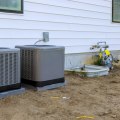
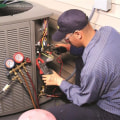
At Filterbuy HVAC Solutions, we've done enough installations and follow-up service calls in this community to know where the money gets lost. It's rarely the equipment. It's an incorrect refrigerant charge that was never caught. It's a duct system that was leaking conditioned air into an attic before anyone noticed. It's a system that was oversized because the contractor estimated by square footage instead of running a proper load calculation — and now it short-cycles through Florida's humidity without ever dehumidifying the space correctly.
In a climate where your system runs most of the year, those errors don't show up once. They show up on every utility bill for as long as that system is running.
This guide breaks down exactly how installation quality affects what you pay each month — and what to look for when choosing top HVAC system installation near Altamonte Springs FL to make sure your next system actually delivers the efficiency it was designed to.
TL;DR Quick Answers
How Proper HVAC Installation Affects Energy Bills in Altamonte Springs FL
Proper HVAC installation is the single biggest factor determining what Altamonte Springs homeowners pay on their energy bills — more than equipment brand, more than efficiency rating, and more than system age.
The core issue most homeowners never hear about:
NIST research confirms improper installation increases household energy use by up to 30%
The DOE estimates 65%+ of residential systems are underperforming due to installation faults — not equipment failure
In Altamonte Springs, systems run 10-plus months per year — every installation shortcut compounds across nearly every billing cycle
What a proper installation actually requires:
Manual J load calculation completed before any equipment is selected
Existing ductwork assessed and leakage-tested before the new system is connected
Refrigerant charge verified to manufacturer specifications — not estimated
Airflow confirmed across the indoor coil and documented before the technician leaves
Seminole County building permit pulled as standard — not optional
What it costs when installation isn't done right:
Florida households already pay nearly double the national average for AC — $525 vs. $265 (EIA RECS)
A 30% efficiency loss on top of that baseline means hundreds of dollars in unnecessary annual cost
Duct leakage rates of 20-30% mean nearly a third of what the system produces never reaches a living space
Improper installation faults cost U.S. homeowners an estimated $2.5 billion in wasted energy annually (NREL)
Money available before installation day:
Duke Energy rebates up to $1,000 on qualifying HVAC replacements
FPL instant $200 invoice credit on qualifying systems
Federal tax credits up to $2,000 on qualifying heat pumps under IRS Section 25C
One thing to know: The homes with the highest unexplained bills in this community aren't running the oldest equipment. They're running newer systems that were never installed correctly — wrong size, unverified refrigerant, ductwork that was never assessed. Getting the installation right from day one is the decision with the highest financial return in Florida's climate.
Top Takeaways
Installation Quality Determines What You Actually Pay — Not the Efficiency Rating on the Box
The DOE estimates 65%+ of residential HVAC systems underperform due to installation faults — not equipment failure
A higher SEER2 rating means nothing if refrigerant charge, airflow, and ductwork aren't verified at installation
In Altamonte Springs, systems run 10-plus months per year — every installation shortcut compounds into real, recurring cost
Altamonte Springs' Climate Makes Every Installation Decision More Consequential
Florida households pay nearly double the national average for AC annually — $525 vs. $265 (EIA RECS)
96% of Florida households use air conditioning — the highest utilization rate of any state in the country
The payback period on a properly installed system is shorter here than almost anywhere else in the U.S.
A Manual J Load Calculation Is Non-Negotiable — Not Optional
Oversizing is the most common and most misunderstood installation mistake we encounter in this community
An oversized system cools air temperature quickly but short-cycles before removing humidity
The result: clammy indoor air, higher energy consumption, and shortened equipment lifespan
No contractor should recommend a system without completing a proper load calculation first
Real Money Is Available Before Installation Day — But Only If You Know to Ask
Duke Energy rebates: up to $1,000 on qualifying HVAC replacements
FPL instant credit: $200 applied directly to your invoice at time of purchase
Federal tax credits: up to $2,000 on qualifying heat pumps under IRS Section 25C
Eligibility windows and prerequisites make timing critical — confirm before equipment is ordered
Your HVAC System Is Your Home's First Line of Defense for Indoor Air Quality
In Central Florida's climate, proper installation controls year-round humidity levels
Humidity management determines whether mold becomes a problem in your home
Consistent airflow from a correctly sized, properly commissioned system directly affects what your family breathes daily
The installation decision is not just a comfort decision — it's a health decision
Most people assume their energy bill reflects how efficient their HVAC system is. What it actually reflects is how efficiently their system is operating — and those two things are often very different in Altamonte Springs homes.
A system's rated efficiency assumes perfect installation conditions. Incorrect refrigerant charge, restricted airflow, or leaky ductwork can quietly erase 20% to 30% of that rated efficiency before your first bill arrives. In a market where your system runs most of the year, that gap between rated and actual performance isn't a minor footnote — it's a meaningful recurring expense.
The Four Installation Factors That Drive Up Energy Bills
From the installations and service calls we've completed across this community, four factors consistently separate the homes with high bills from the ones running efficiently:
1. Refrigerant Charge An improperly charged system works harder to reach the same output. Too little refrigerant and the compressor strains under conditions it was never designed to handle. Too much and efficiency drops just as sharply. Either way, your bill reflects the difference every month. Verifying charge to manufacturer specifications on installation day is non-negotiable — and something every legitimate contractor should document.
2. Airflow Across the Indoor Coil Restricted airflow is one of the most common and least visible installation faults we encounter. When air can't move across the coil properly, the system loses its ability to transfer heat efficiently. The result is longer run times, higher consumption, and a home that never quite feels right regardless of what the thermostat says. This is frequently caused by undersized return ducts — a structural issue that existed before the new system arrived and should have been identified during the pre-installation assessment.
3. Duct System Integrity In Altamonte Springs, a significant number of homes — particularly those built before the 1990s — have duct systems that were never designed to support today's higher-efficiency equipment. Leaky or disconnected ducts bleed conditioned air directly into unconditioned spaces like attics and wall cavities. The system keeps running to compensate, consuming energy to condition space it was never intended to reach. We've found duct leakage rates in local homes exceeding 30% — meaning nearly a third of what the system produces never reaches a living space.
4. System Sizing Oversizing is the installation mistake that generates the most calls and the most confusion. A system that's too large cools the air temperature quickly but shuts off before it has time to remove the humidity — leaving Altamonte Springs homes feeling clammy and uncomfortable even at the correct set point. Short-cycling also puts disproportionate wear on the compressor, shortening the system's lifespan while simultaneously increasing energy consumption. Proper sizing requires a Manual J load calculation that accounts for your home's specific insulation, ceiling height, window placement, and sun exposure — not a rule of thumb based on square footage.
Why Florida's Climate Makes Every Installation Error More Expensive
What distinguishes Altamonte Springs from markets where installation quality is still important but less urgent is runtime. A system here doesn't run four or five months a year — it runs ten. According to the U.S. Energy Information Administration, Florida's hot-humid climate zone homeowners pay approximately 27% of their total home energy expenditures on cooling alone.
That means every percentage point of efficiency lost to a poor installation compounds across more operating hours than almost anywhere else in the country. An installation fault that costs a homeowner in a northern climate $80 a year may cost an Altamonte Springs homeowner $200 or more — year after year, for the life of the system.
What Proper Installation Actually Looks Like
A properly installed HVAC system in Altamonte Springs involves more than connecting equipment and confirming it turns on. From our experience, the installations that consistently deliver on their rated efficiency share a defined set of practices:
Manual J load calculation completed before any equipment is selected or ordered
Duct system assessment including leakage testing and airflow verification before the new unit is connected
Refrigerant charge verified to manufacturer specifications using accurate gauges — not estimated
Airflow measured and confirmed against the system's design specifications
Building permit pulled through Seminole County, ensuring a third-party inspection confirms code-compliant installation
Post-installation diagnostics reviewed with the homeowner before the technician leaves
Each of these steps exists because skipping any one of them creates a performance gap that shows up on your utility bill — quietly, consistently, for years.
The Long-Term Cost of Getting It Wrong
We've walked through homes where the previous system was replaced less than five years ago and the homeowner was already experiencing performance problems and elevated bills. In nearly every case, the equipment wasn't the issue. The installation was — and by the time we arrived, the damage had already been done across hundreds of monthly billing cycles.
Correcting a poor installation after the fact is possible but rarely straightforward. Duct repairs, refrigerant corrections, and airflow modifications add cost and disruption that could have been entirely avoided. The homeowners who fare best are the ones who insisted on a thorough pre-installation assessment and a contractor willing to document every step of the process.
Getting the top HVAC installation right the first time isn't a premium service. It's the standard every Altamonte Springs homeowner deserves — and the one we hold ourselves to on every job we complete in this community. If you're planning a new installation or suspect your current system isn't performing the way it should, we offer free, no-pressure assessments seven days a week.
"We've walked into homes with systems less than three years old that were consuming energy like equipment twice their age. The homeowner thought they had a bad unit. What they actually had was a bad installation — an incorrect refrigerant charge, return ducts too small for the equipment, and a duct system that was never tested before the new unit was connected. None of it was visible on installation day. All of it was visible on every utility bill since. In Altamonte Springs, where your system runs most of the year, a poor installation doesn't just cost you once — it costs you every single month until someone finally identifies what went wrong and fixes it."
Essential Resources
We've put together the resources that matter most before any installation decision gets made. These are the same steps we walk our own customers through — because getting this right from the start is how you protect your home, your comfort, and your investment.
Confirm Your Contractor Is Licensed Before Anyone Enters Your Home
Florida requires every HVAC contractor to hold a current state license — and it takes about 30 seconds to verify one. Look up any contractor by name or license number at the Florida DBPR portal before work begins. We always welcome verification. A contractor who doesn't is telling you something important. https://www2.myfloridalicense.com/
Make Sure Your Installation Gets Permitted Through Seminole County
Every HVAC installation in Altamonte Springs requires a building permit under Florida Statute Chapter 489. We pull every permit on every job — no exceptions. Unpermitted work voids manufacturer warranties on major brands and creates real problems when it's time to sell your home. This is where permits are managed for our area. https://www.seminolecountyfl.gov/departments-services/development-services/building
Learn What a Proper Installation Actually Looks Like
Most homeowners never see this resource — and most contractors are counting on that. The EPA's ENERGY STAR quality installation guidelines detail exactly what refrigerant charge verification, duct leakage testing, and load-based sizing should involve. Read it before you talk to any contractor, including us. An informed homeowner gets a better installation every time. https://www.energystar.gov/saveathome/heating-cooling/hvac-quality-installation
Verify Your Equipment Meets Current Florida Efficiency Standards
Before committing to any system, use ENERGY STAR's certified product finder to confirm it meets current SEER2 minimums for Florida's climate zone. We only recommend equipment that clears this bar — but it's worth verifying independently. A system running 10 months a year in Altamonte Springs needs to earn every efficiency rating on its label. https://www.energystar.gov/productfinder/product/certified-central-air-conditioners-heat-pumps/
Check Duke Energy Rebate Eligibility Before Equipment Is Ordered
Duke Energy Florida customers in Altamonte Springs may qualify for up to $1,000 back on a qualifying HVAC replacement. One detail most homeowners miss: the free Home Energy Check must be completed within 24 months before installation to qualify. Check eligibility early — this isn't a step you can go back and add after the fact. https://www.duke-energy.com/Home/Products/Home-Energy-Improvement/HVAC-Replacement?jur=FL01
FPL Customers Can Get an Instant $200 Credit at Time of Purchase
Florida Power & Light customers may qualify for an instant $200 invoice credit on qualifying systems rated SEER2 15.2 or higher when installed by an approved contractor. No rebate paperwork after the fact — the credit is applied directly at purchase. Confirm your utility provider and contractor eligibility before your installation is scheduled. https://www.fpl.com/save/programs/ac-rebate.html
Federal Tax Credits Can Reduce Your Net Installation Cost Significantly
Homeowners who installed qualifying HVAC systems before December 31, 2025 may be eligible for a federal tax credit of up to $2,000 for qualifying heat pumps and up to $600 for central air conditioners under IRS Section 25C. Claim it on Form 5695 with your federal return for the year of installation. Confirm current program status with a tax professional — we flag this resource for every customer because it changes the real cost of the decision. https://www.irs.gov/credits-deductions/energy-efficient-home-improvement-credit
Before making any installation decision, these essential resources help you verify licensing, permits, efficiency standards, rebates, and tax credits—ensuring you hire the right professional for HVAC installation and protect your home, comfort, and long-term investment.
Supporting Statistics
We share these numbers with every homeowner before an installation. The research confirms what we see in homes across this community every week. The data and the field experience tell the same story.
More Than 65% of Residential HVAC Systems Are Underperforming From Day One
The U.S. Department of Energy estimates more than 65% of residential HVAC systems are improperly installed and operating below rated efficiency. The most documented faults are ones we find regularly in Altamonte Springs homes — on systems that are two or three years old and still under warranty.
The pattern we find is almost always the same:
Refrigerant levels were never verified to manufacturer specifications
Return ducts were undersized for the system connected to them
Duct leakage that existed before the new unit arrived was never identified or addressed
These aren't catastrophic failures. They're quiet, compounding errors that don't show up on installation day. They show up on every utility bill that follows.
Where the efficiency goes:
Incorrect refrigerant charge forces the compressor to strain beyond design conditions
Insufficient airflow across the indoor coil extends run times with no visible warning sign
Duct leakage pushes conditioned air into attics and wall cavities while the thermostat keeps calling for more
Source: U.S. Department of Energy — Field Study to Characterize Fault Prevalence in Residential Comfort Systems https://www.energy.gov/eere/buildings/field-study-characterize-fault-prevalence-residential-comfort-systems
Improper Installation Costs U.S. Homeowners an Estimated $2.5 Billion in Wasted Energy Every Year
A model developed by the National Renewable Energy Laboratory (NREL), published through the DOE's Building America Solution Center, estimates:
Approximately 9% of all residential HVAC energy consumption nationwide is directly attributable to installation-related faults
That 9% translates to roughly $2.5 billion in unnecessary utility costs paid by American homeowners every year
The faults responsible aren't always dramatic. The NREL model confirms what we've observed firsthand across Altamonte Springs homes:
An airflow reduction of just 15% produces measurable, ongoing increases in energy consumption
A refrigerant undercharge of 20% does the same — with no visible sign of a problem
Neither deviation would be noticed on a walk-through, but both show up on every bill the system generates
The homes we've walked into with the highest unexplained bills aren't the oldest. They're the ones where a newer system was connected to an unassessed duct system, charged without verified numbers, or sized without a load calculation. The waste was built in before the homeowner ever touched the thermostat.
Why this matters more in Altamonte Springs:
Installation faults compound silently across every billing cycle for the life of the system
Florida's extended cooling season amplifies every installation error far beyond what the same fault would cost in a cooler climate
Getting the installation right the first time isn't a premium — it's the decision with the highest return in this market
Source: DOE Building America Solution Center — Heat Pump Quality Installation and Commissioning (citing NREL 2020) https://basc.pnnl.gov/resource-guides/heat-pump-quality-installation-and-commissioning
Florida Households Pay the Highest Air Conditioning Costs of Any Climate Region in the Country
The U.S. Energy Information Administration's Residential Energy Consumption Survey (RECS) puts hard numbers behind something every Altamonte Springs homeowner deserves to understand before making an installation decision:
Key data points from the EIA RECS:
Florida households pay an average of $525 annually for air conditioning — nearly double the national average of $265
96% of Florida households use air conditioning — the highest utilization rate of any state in the country
90% of Florida households rely on central systems — confirming that installation quality affects virtually every home in this market
We don't need a federal survey to know that Altamonte Springs homeowners run their systems year-round. We see it in every job we complete and every maintenance call we respond to in this community. But the EIA data makes the financial stakes concrete:
What this means in practice:
A homeowner in a northern climate absorbs a poor installation's consequences across roughly 5 months of operation per year
An Altamonte Springs homeowner absorbs those same consequences across 10 or more months
That difference turns a manageable annual cost overrun into a significant recurring expense — for the entire life of the equipment
The bottom line: In no other U.S. market does installation quality have a more direct and measurable impact on what a homeowner pays each month. The payback period on a properly installed, correctly sized, thoroughly commissioned system is shorter here than almost anywhere else in the country.
Source: U.S. Energy Information Administration — Air Conditioning Accounts for About 12% of U.S. Home Energy Expenditures (2015 RECS) https://www.eia.gov/todayinenergy/detail.php?id=36692
Final Thought
The homeowners who fare best aren't the ones who bought the most expensive system. They're the ones who asked the most questions before anyone picked up a tool.
The DOE, NREL, and NIST all point to the same conclusion — installation quality determines real-world performance more than brand or efficiency rating. But data doesn't fully capture what we see on the ground. Walking into a home where a family has been overpaying for three years on a system that should have performed correctly from day one sharpens your perspective on what this work actually means.
What the research confirms and what we see firsthand:
Most performance problems trace back to decisions made before installation began — not the equipment
Wrong sizing, skipped load calculations, and unassessed ductwork form a pattern we encounter repeatedly across this community
The best equipment delivers its rated efficiency only when installed to the standard that rating assumes
In Florida's climate, every installation shortcut compounds into real, recurring cost across 10-plus months of operation per year
The point most guides miss:
In Altamonte Springs, your HVAC system isn't just a comfort appliance. It's your home's primary defense against year-round humidity, seasonal pollen, and indoor air quality challenges unique to Central Florida's climate.
A properly installed system does more than lower your bill:
Controls moisture levels that determine whether mold becomes a problem
Maintains consistent airflow that directly affects what your family breathes daily
Prevents the "adjusted expectations" pattern — rooms that always feel warm, systems that always struggle, bills that are always higher than they should be
In most homes where we find these problems, the issue wasn't unsolvable. It was one installation that wasn't done right and was never properly evaluated afterward.
Our honest opinion after working in this community:
The HVAC industry doesn't always make it easy for homeowners to know what a proper installation looks like.
Permits get skipped
Load calculations get estimated rather than calculated
Duct systems get connected without leakage testing
These shortcuts don't make noise. They don't trigger warning lights. They quietly increase what you pay every month until someone finally identifies what went wrong.
What Altamonte Springs homeowners deserve is an installation that treats the efficiency rating on the equipment as a floor, not a ceiling. Every verification step, every permit pulled, every duct assessment completed before connection day exists for one reason — the homeowner paid for a system designed to perform at a specific standard, and our job is to make sure it gets there.
Five things we'd tell every Altamonte Springs homeowner before an installation:
Verify your contractor's license before the conversation goes further — https://www2.myfloridalicense.com/
Insist on a Manual J load calculation — square footage estimates are not load calculations
Have existing ductwork assessed and leakage-tested before a new system is connected
Confirm rebate and tax credit eligibility before equipment is ordered — not after
Choose a contractor who will still be your neighbor when the job is done
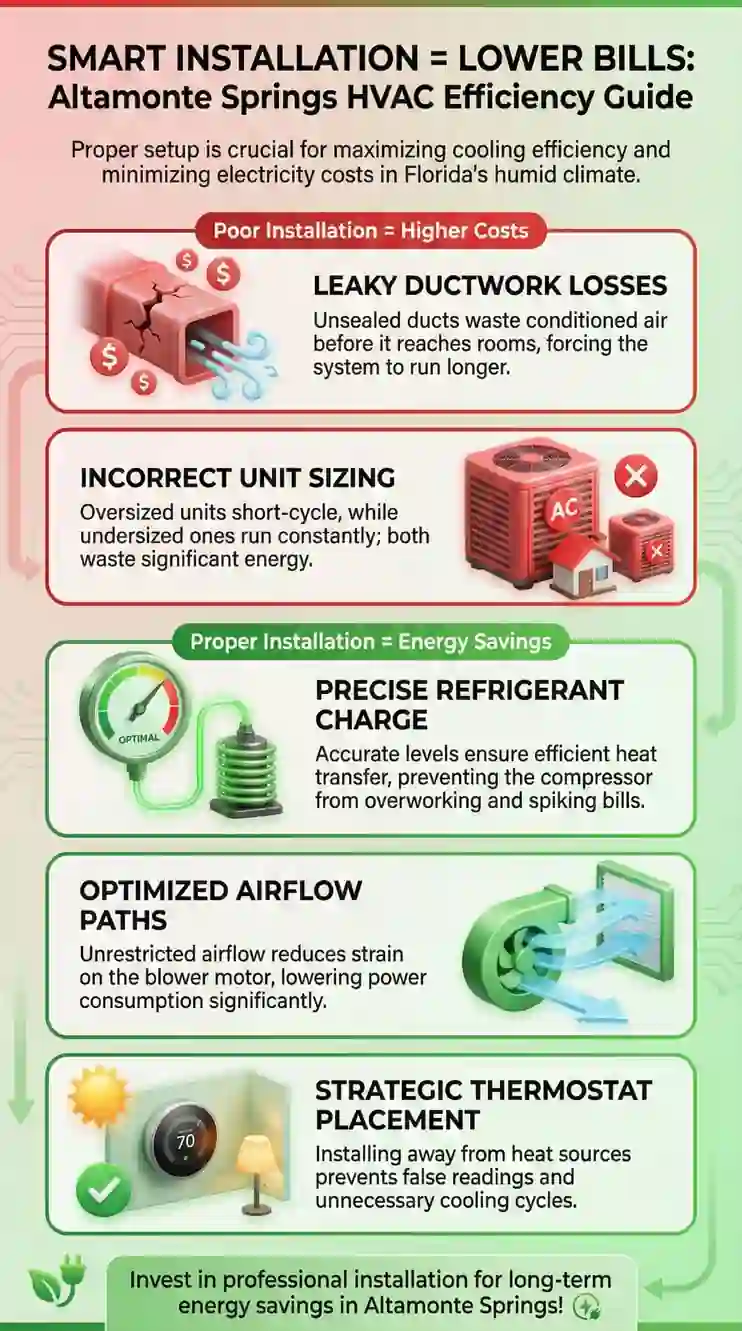
FAQ on How Proper HVAC Installation Affects Energy Bills in Altamonte Springs
Q: How much can improper HVAC installation increase my energy bills in Altamonte Springs?
A: Significantly — and in Florida's climate, the cost builds faster than anywhere else. NIST research found improper installation can increase household heating and cooling energy use by approximately 30%. In Altamonte Springs, that penalty applies to nearly every billing cycle of the year — not just a few months of seasonal operation.
The problem is rarely the equipment. It's almost always one of four things:
Refrigerant that was never verified to manufacturer specifications
Return ducts too small for the system connected to them
Duct leakage that existed before the new unit arrived and was never addressed
A system oversized because the contractor skipped the load calculation
Where the 30% efficiency loss goes:
Incorrect refrigerant charge — compressor strains beyond design conditions from day one
Insufficient coil airflow — run times extend with no visible warning sign
Duct leakage — conditioned air reaches attics and wall cavities instead of living spaces
Oversizing — system short-cycles through humidity without ever resolving it
Q: What is a Manual J load calculation and why does it matter for my energy bills?
A: A Manual J load calculation determines what size system a specific home actually requires. It accounts for square footage, ceiling height, insulation, window placement, sun exposure, and local climate. It's the difference between a system designed for your home and a system guessed for your home.
What happens without one:
Oversized system — cools fast, short-cycles, leaves humidity unresolved, wears the compressor prematurely
Undersized system — runs continuously, can't meet demand during peak Florida heat
Either way — the homeowner pays more and feels less comfortable than a correctly sized system delivers
What we've seen in Altamonte Springs homes:
Previous contractors recommended systems one to two tons larger than the space required
Homeowners paid more for the equipment and more to run it every month
Homes read the correct temperature on the thermostat but still felt wrong
The cause every time: a sizing problem that started before installation day
Q: How does duct condition affect my HVAC system's energy efficiency in Altamonte Springs?
A: More than most contractors address before connecting a new system. DOE Building America Solution Center research confirms that when duct leakage is factored alongside other common faults, error rates climb to 90-100% of residential systems.
What we find when assessing ducts in Altamonte Springs homes before installation:
Leakage rates regularly exceeding 20-30% — nearly a third of what the system produces never reaches a living space
Undersized return ducts that starve the system of airflow and force extended run times
Disconnected duct sections in attic spaces silently bleeding conditioned air for years
Why this matters more in older Altamonte Springs homes:
A significant share of local homes were built before the 1990s
Duct systems in these homes were designed for equipment that no longer exists
Connecting a modern high-efficiency system to that infrastructure without assessment guarantees underperformance
The previous system was compensating for duct deficiencies — the new system will too, unless ductwork is addressed first
Q: What should I look for when choosing an HVAC installation company near Altamonte Springs to ensure lower energy bills?
A: The contractor determines real-world performance far more than the brand of equipment they install. After working across this community, four non-negotiable practices separate quality installations from problematic ones:
Manual J load calculation completed before any equipment is recommended — square footage estimates are not load calculations
Existing ductwork assessed and leakage-tested before the new system is connected — not after problems surface
Seminole County building permit pulled without hesitation — unpermitted work voids manufacturer warranties and creates liability when selling your home
Refrigerant charge and airflow verified to manufacturer specifications post-installation — with results documented before the technician leaves
Quick Answer: A contractor who covers all four without being asked isn't cutting corners anywhere else. That combination is what separates a system performing at rated efficiency from one quietly underperforming for years.
Verify any contractor's Florida license before signing anything: https://www2.myfloridalicense.com/
Q: How long will it take to see lower energy bills after a properly installed HVAC system in Altamonte Springs?
A: For most Altamonte Springs homeowners replacing an older or poorly installed system, the difference appears on the first full billing cycle. A correctly installed, properly sized system with verified refrigerant charge and assessed ductwork performs at rated efficiency from day one — not after a break-in period.
What determines the magnitude of savings:
How far off the previous installation was — oversizing, duct leakage, and unverified refrigerant levels all compound
Whether ductwork was assessed and repaired as part of the installation
The efficiency gap between the old system and the new one
Why the payback is faster in Altamonte Springs than almost anywhere else:
Florida households pay nearly double the national average for AC — $525 vs. $265 nationally (EIA RECS)
Year-round operation means efficiency gains apply to 10-plus months of billing cycles — not 4 or 5
Every percentage point of efficiency recovered through proper installation translates to immediate, measurable savings
In our article How Proper HVAC Installation Affects Energy Bills in Altamonte Springs, we explain how installation precision directly impacts airflow, system strain, and monthly utility costs—factors that also depend on using the right replacement components. Choosing a quality 15x20x1 MERV 11 air filter helps maintain proper static pressure and system efficiency, while a dependable 22x24x1 MERV 8 HVAC air filter supports consistent airflow and indoor air quality. Even selecting the correct 15x20x1 pleated HVAC furnace filter plays a role in protecting your equipment after installation. Together, proper installation and correctly rated filtration components ensure your HVAC system in Altamonte Springs operates at the efficiency level it was designed to deliver, helping control long-term energy costs.