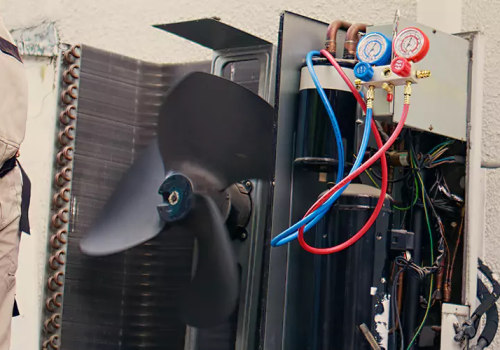
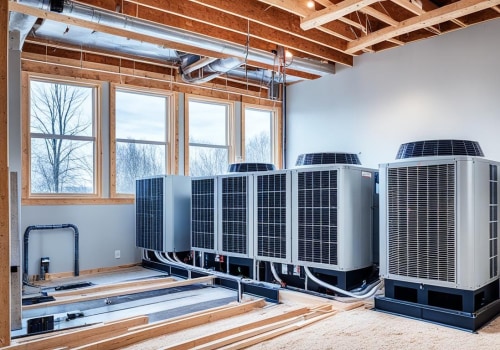
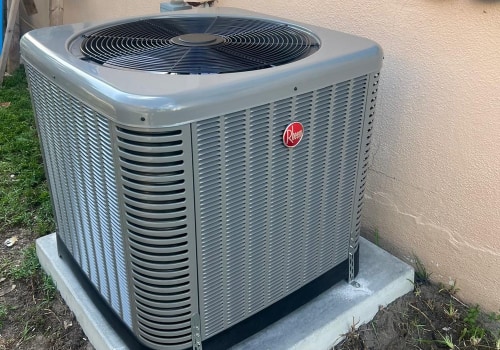
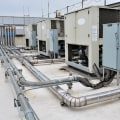
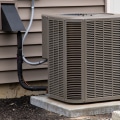
Upgrading the box on the slab won’t resolve any of that. The Clermont homeowner who searches for top HVAC system installation near Clermont FL after a bad replacement needs someone who’ll size, seal, and commission the whole system rather than swap equipment and head to the next job.
TL;DR Quick Answers
Top HVAC System Installation Near Clermont FL
Top HVAC system installation in Clermont, FL starts with a Manual J load calculation, return-duct sizing, and equipment that holds relative humidity below 60% through Central Florida's wet season. We verify any installer's Florida DBPR license at MyFloridaLicense.com before recommending them. The install scope drives indoor air quality more than the equipment brand.
Top Takeaways
Manual J load sizing is the foundation. Without it, even high-end equipment short-cycles and leaves humidity in the air.
Central Florida summer attics run 130–140°F+, so cabinet sealing, return-side insulation, and condensate management determine whether the equipment conditions the air or just spins through cycles.
Pre-2005 Clermont neighborhoods near downtown and Lake Minneola tend to have undersized returns and aging R-4.2 flex ducts that compromise new-equipment performance until the install scope addresses them.
Verify any installer’s Florida DBPR license at MyFloridaLicense.com before signing a contract. The license number is public record and the lookup takes about 90 seconds.
EPA Indoor airPLUS guidance specifies indoor relative humidity below 60% in warm-humid climates. Specify equipment with the latent capacity to hold that target through August. SEER2 is a secondary spec.
How a Clermont HVAC Installation Actually Affects Your Indoor Air
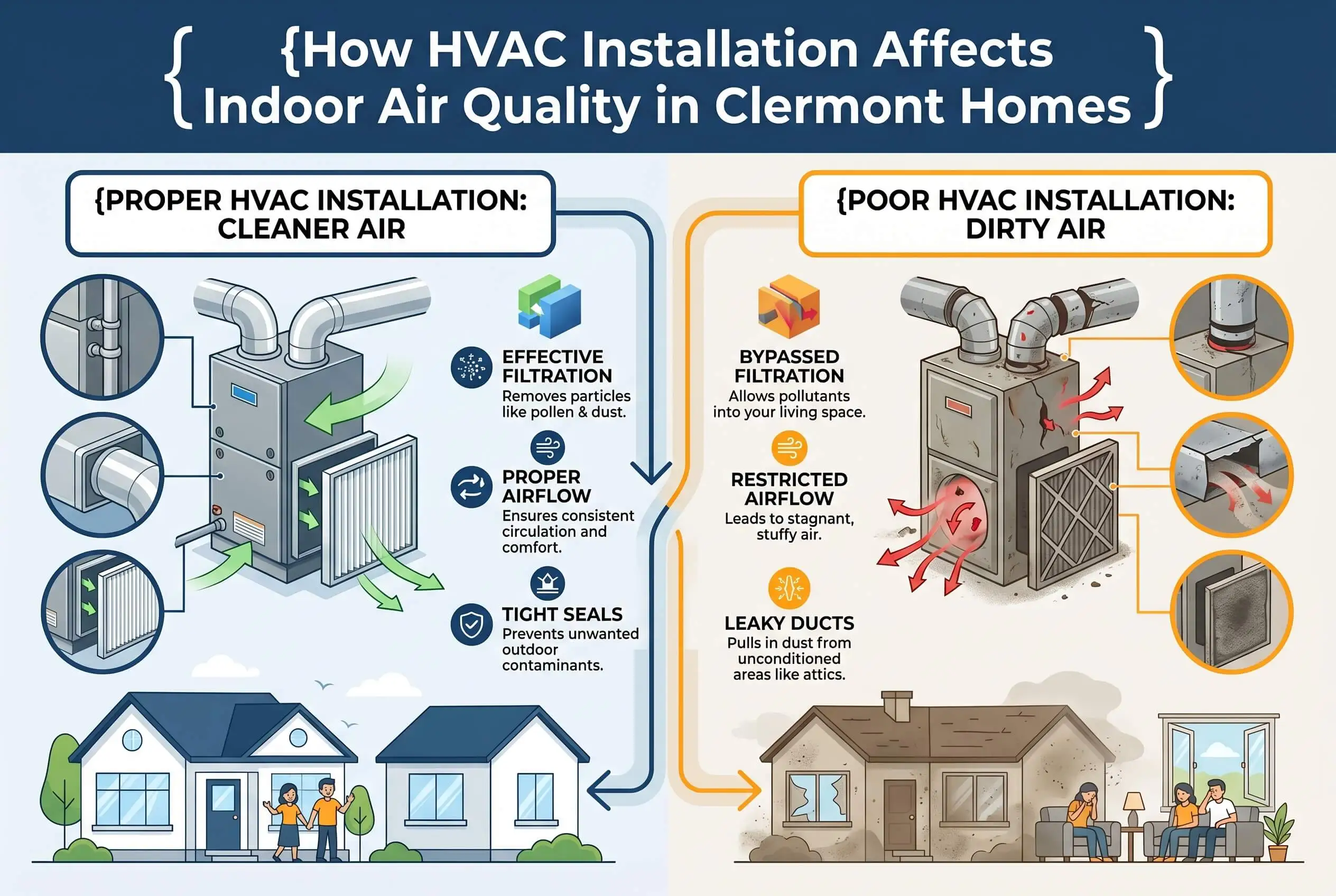
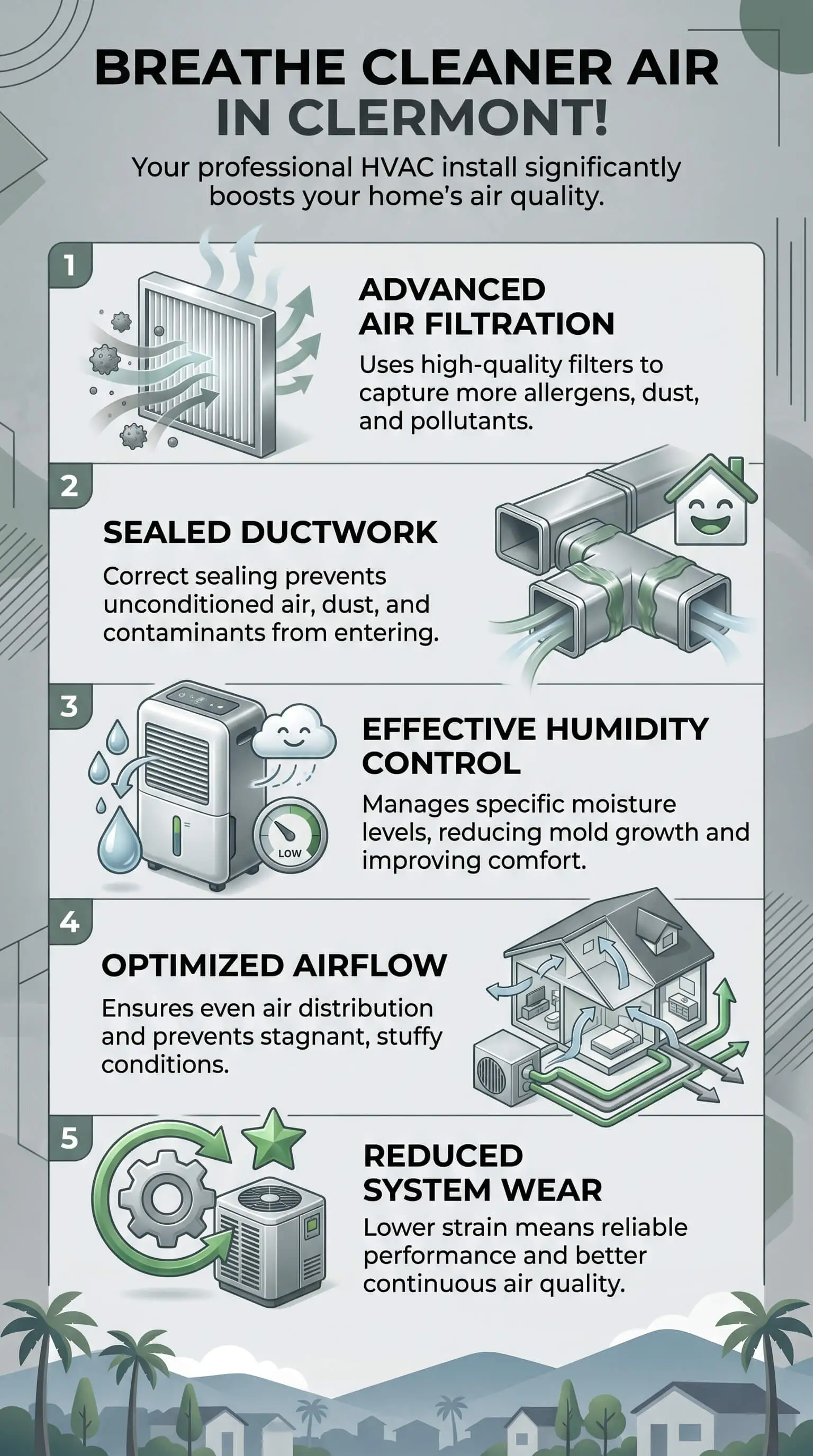
Your HVAC system moves air, filters it, cools it, and pulls humidity out of it in the same cycle. The install has to handle every one of those jobs for indoor air quality to improve after the upgrade. Miss one and the rest can’t make up for it.
Sizing decides whether humidity ever leaves your home
A Clermont home runs cooling close to 280 days a year. The condenser has to match the heat load (square footage, window orientation, attic insulation R-value, infiltration rate, occupancy), not a number pulled off a phone quote. Oversized systems cool fast and shut off before they pull humidity out of the air. The thermostat reads 75°F, indoor humidity sits at 65%, the house feels clammy, the supply registers start sweating. We see this most often in homes where the original equipment was replaced once before with a one-size-bigger unit because someone thought bigger meant better. EPA Indoor airPLUS specifications, which apply to warm-humid climates like Clermont’s, call for equipment that holds relative humidity below 60%. Hitting that target starts with a real Manual J calculation. Equipment selection follows from there.
Ducts decide whether the new equipment ever performs as rated
Ducts are the part of the system homeowners never see, which is often why ducts defeat new equipment. In pre-2005 neighborhoods around downtown Clermont and the Lake Minneola corridor, we routinely find R-4.2 flex duct that’s been baking in 130–140°F summer attics for two decades, jacket failures at the elbows, returns sized 20% to 30% smaller than the new air handler needs, and trunk lines that have lost most of their R-value to compression. Newer master-planned construction in Wellness Way, Olympus, Johns Lake Landing, and Esplanade at Highland Ranch usually has tighter ducts, but builder-grade specifications often skip filtration depth: the four-inch media slot that holds enough surface area to move IAQ readings in any measurable way. Static-pressure testing and Manual D duct sizing belong in every replacement quote. If they’re not in yours, the new equipment is working against the house from day one.
Filtration and dehumidification are the levers that move IAQ
Filtration and dehumidification are the levers that move IAQ. Once the system is sized correctly and the ducts are doing their job, a professional HVAC system installation focuses on the two pieces that decide what your indoor air quality looks like by August: a filter rack that holds a four-inch MERV 11 to MERV 13 media filter (one-inch slots can’t hold high-MERV media without choking airflow), and either a high-latent-capacity coil or a dedicated dehumidifier tied into the return. For homes off Lake Louisa, the older neighborhoods around the Citrus Tower, and new construction along the Wellness Way corridor, dehumidification is what we tell homeowners to address first when allergy or asthma symptoms are the reason for the call.
“In Clermont’s pre-2005 homes around the Lake Minneola corridor, we routinely find return ducts sized 20% to 30% smaller than what the new equipment needs. Pair that with an air handler running in a 135°F summer attic and the system can’t pull humidity out of the air, no matter how efficient the condenser rating is. The pattern we see most often is a homeowner who’s replaced their AC twice and still has a sticky house. Right-sizing the return and sealing the duct envelope before the new equipment goes in is what moves indoor air quality readings, in our experience.”
Essential Resources
Each of these is a primary source we point Clermont homeowners to when they want to verify what we’ve recommended or read further.
EPA — Improving Indoor Air Quality — Federal guidance on the three core levers (source control, ventilation, filtration) that determine indoor air quality.
EPA Indoor airPLUS — Benefits and Features — The construction specifications used as the IAQ benchmark for new and renovated homes in warm-humid climates.
ENERGY STAR — Heating & Cooling — Equipment efficiency criteria and guidance on what to look for when specifying a replacement system.
Florida DBPR — License Search (MyFloridaLicense.com) — The state license verification database. Use this before signing a contract with any HVAC contractor in Florida.
Wikipedia — Heating, ventilation, and air conditioning — Background on the underlying systems and engineering principles behind residential HVAC.
City of Clermont, FL — Official Website — Municipal building services, permits, and inspection scheduling for HVAC work inside Clermont city limits.
Lake County, FL — Official Government Website — County-level building services and permitting for properties in unincorporated Lake County.
Supporting Statistics
Americans spend approximately 90% of their time indoors. Source: U.S. Environmental Protection Agency. https://www.epa.gov/indoor-air-quality-iaq
Indoor concentrations of some pollutants can be two to five times higher than typical outdoor concentrations. Source: U.S. Environmental Protection Agency. https://www.epa.gov/indoor-air-quality-iaq/introduction-indoor-air-quality
EPA Indoor airPLUS construction specifications call for HVAC equipment that holds relative humidity below 60% in warm-humid climates such as Florida. Source: U.S. Environmental Protection Agency, Indoor airPLUS. https://www.epa.gov/indoorairplus
These findings reinforce why a top HVAC installation matters in Florida homes, where Americans spend most of their time indoors and indoor pollutant levels can be significantly higher than outdoor air. Proper humidity control, airflow design, and correctly sized HVAC equipment help maintain healthier indoor air quality and keep relative humidity below the EPA-recommended 60% threshold for warm, humid climates like Clermont.
Final Thoughts and Opinion
The Clermont homes that hold the cleanest indoor air through August have one thing in common: the installer pulled a Manual J before quoting, pressure-tested the ducts before swinging the equipment in, sized the return to match the new system’s airflow, and chose the best HVAC system for home comfort with a coil that has enough latent capacity to hold the house under 60% relative humidity year-round. Equipment quality is a secondary variable. If a homeowner here asks where to start when something feels off in the house, we’ll walk it together with a temperature and humidity reading at every supply register before talking about replacement at all.
Frequently Asked Questions
How long does a complete HVAC installation take in a Clermont home?
A standard residential changeout in a Clermont home typically takes one full day for a straight equipment swap, two days when returns are being resized or duct sealing is part of the scope, and three days for a full duct replacement alongside the equipment. Permitting through City of Clermont Building Services or Lake County adds lead time on the front end. We give you a firm schedule once we’ve walked the home.
Will a new HVAC system actually improve my home’s indoor air quality?
Yes, but only if the install addresses the parts of the system that affect your air. New equipment alone won’t solve dust and humidity if the returns are undersized, the ducts are leaking into the attic, or the filter rack can’t hold a four-inch media filter. The installation scope matters more than the equipment SEER2 rating for IAQ outcomes.
What MERV filter rating is appropriate for a Clermont, FL home?
A four-inch MERV 11 to MERV 13 media filter is what we recommend for most Clermont homes. MERV 11 captures most pollen, dust, and pet dander. MERV 13 adds finer particulates including some allergens that matter for asthma sensitivity. One-inch filter slots usually can’t accommodate these filters without restricting airflow, so the filter rack itself sometimes needs to change with the equipment.
Do I need permits for HVAC replacement in Clermont, FL?
Yes. HVAC equipment replacement inside Clermont city limits and in unincorporated Lake County requires a permit pulled by the licensed contractor, plus a final inspection. The permit covers electrical and mechanical work. Any contractor who suggests skipping the permit is one to walk away from. City of Clermont Building Services and Lake County Building Services issue these permits.
How do I verify my Clermont HVAC contractor’s Florida license?
Visit MyFloridaLicense.com, choose “Verify a License,” and search by the contractor’s name or license number. The state database returns active status, license type (CAC for HVAC contractors), and any complaint history. This is a public record and takes about 90 seconds. We recommend doing this before any homeowner in Clermont signs a contract.
Are there Duke Energy rebates for new HVAC installation in the Clermont area?
Duke Energy has historically offered rebates for qualifying high-efficiency residential HVAC installations in their Florida service territory, which includes most of Lake County. Current rebate amounts, equipment eligibility, and program availability change year to year. We confirm the current rebate terms with Duke Energy at the time of quoting, so you know up front what your installation costs after incentives.
What indoor humidity level should my Clermont home maintain year-round?
EPA Indoor airPLUS guidance for warm-humid climates like Clermont’s specifies indoor relative humidity below 60% year-round. We aim for 45% to 55% in the homes we work in. Below 45% gets dry and uncomfortable. Above 60% lets mold colonies establish in carpet, drywall, and HVAC components. A properly sized system with adequate latent capacity holds this range without a separate dehumidifier in most homes.
Schedule a Walkthrough Before You Replace
If your HVAC system is past the ten-or-twelve-year mark, or your Clermont home runs sticky through the wet season no matter what the thermostat reads, we’d come out and walk through it with you. We’ll run the load calculation, look at your duct system, and write up an estimate showing exactly what a properly specified install would look like for your home. No commitment beyond the walkthrough.
Clean indoor air starts with more than just replacing equipment, which is why understanding How HVAC Installation Affects Indoor Air Quality in Clermont Homes is important for homeowners dealing with humidity, dust, and airborne allergens throughout Central Florida. Proper HVAC installation paired with effective filtration helps maintain balanced airflow, lower indoor contaminants, and improve overall system efficiency. Products like these 12x20x1 MERV 8 pleated HVAC air filters and dependable pleated furnace air filters support cleaner circulation by trapping common airborne particles before they move through the home. When combined with properly sealed ductwork, accurate system sizing, and humidity control, quality air filtration becomes a major factor in creating healthier indoor air conditions for Clermont homeowners year-round.